Category: Toy Spotlight of the Week

Castle Grayskull (Mattel – 1982)

BY THE POWER OF GRAYSKULL!

This Toy Spotlight focuses on a true legend from Mattel, and an item that would become a symbol for an entire decade of toys in the 1980’s. The Masters of the Universe brand was a huge hit at the time, to say the very least. It was enjoying worldwide success with their popular animated series and top selling toy line. Mattel certainly gave us plenty of figures and accessories for the line, but their playsets were simply incredible! By the time Masters of the Universe toys hit the stores in 1982, kids were snatching them off the shelves as fast as they landed. Yes, everyone wanted the figures, with He-Man and Skeletor being front and center. Battle Cat was certainly super cool and the vehicles were fun, but the item that EVERY kid in the world wanted at that time was the lone playset released that year. So without further ado, I humbly present Mattel’s Castle Grayskull Playset from 1982.
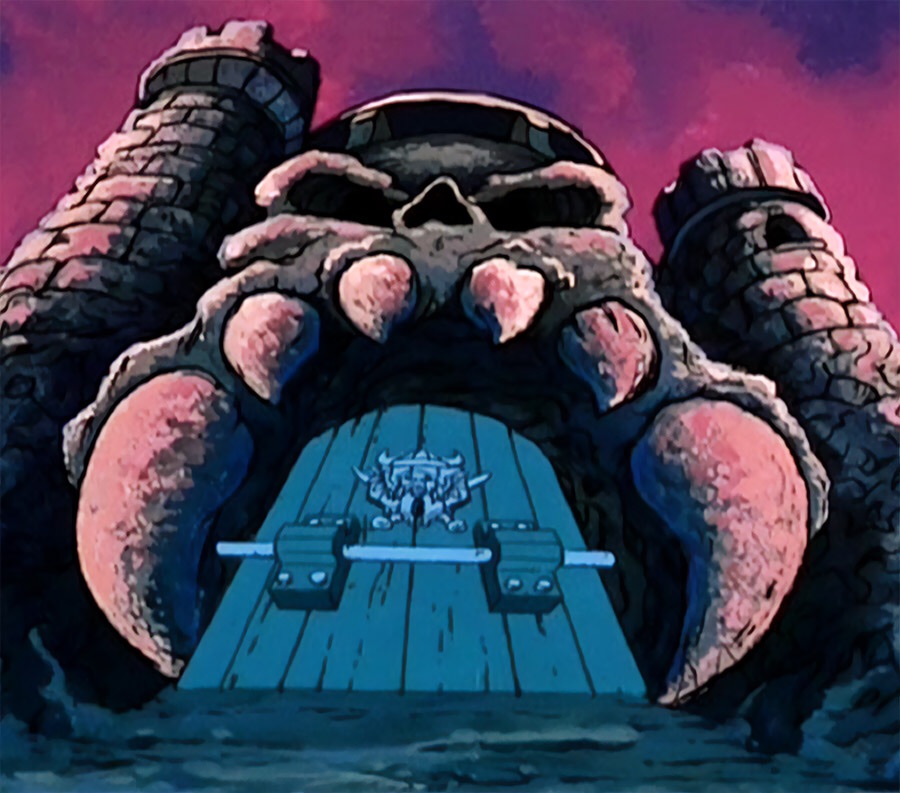
Aside from He-Man and Skeletor themselves, Castle Grayskull is the most iconic item to come from of the Masters of the Universe line. The image of the legendary castle can be instantly recognized by anyone who grew up in that era. With its trap door, opening and closing drawbridge, throne, laser cannon and weapons armory, there was a lot to do in this playset, not to mention a most impressive front exterior shot of the skull with fangs. In short, this set was just plain cool looking! With a price tag of $24.99 at the time, it was a reasonably priced addition for any child’s toy stash. It was kind of like the Barbie Town House for boys! This thing proved so popular with fans and collectors that it has been re-released twice since then, with the Masters of the Universe Classics version in 2013 (which is crazy expensive nowadays) and the Masters of the Universe Origins version from 2021.
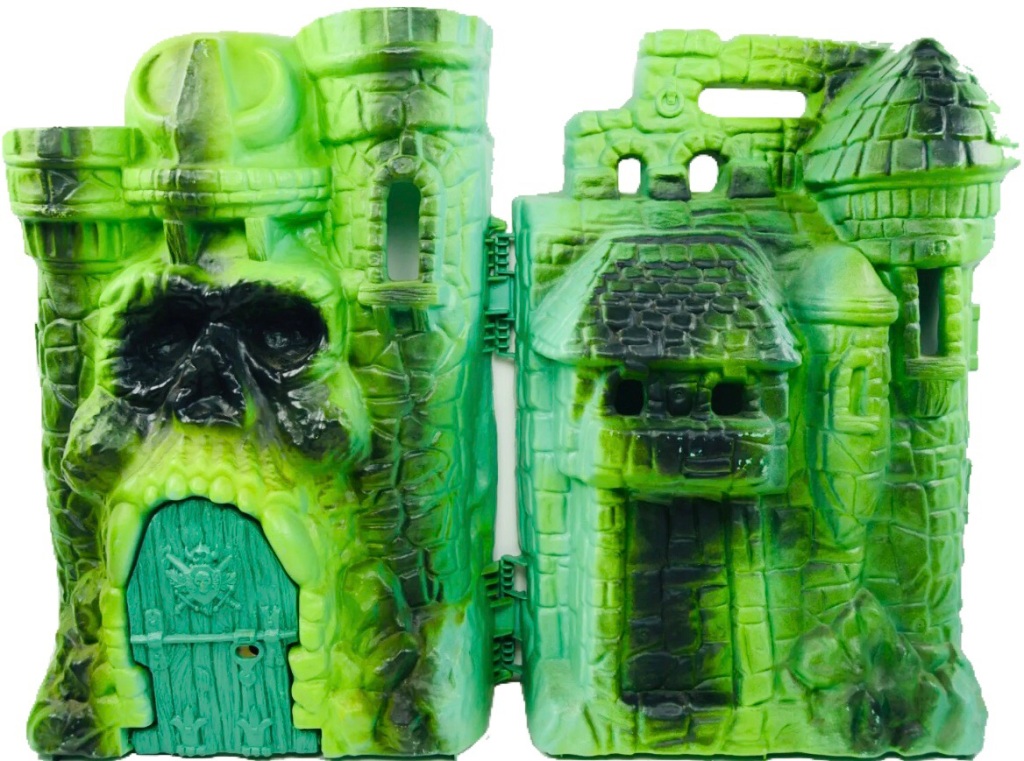
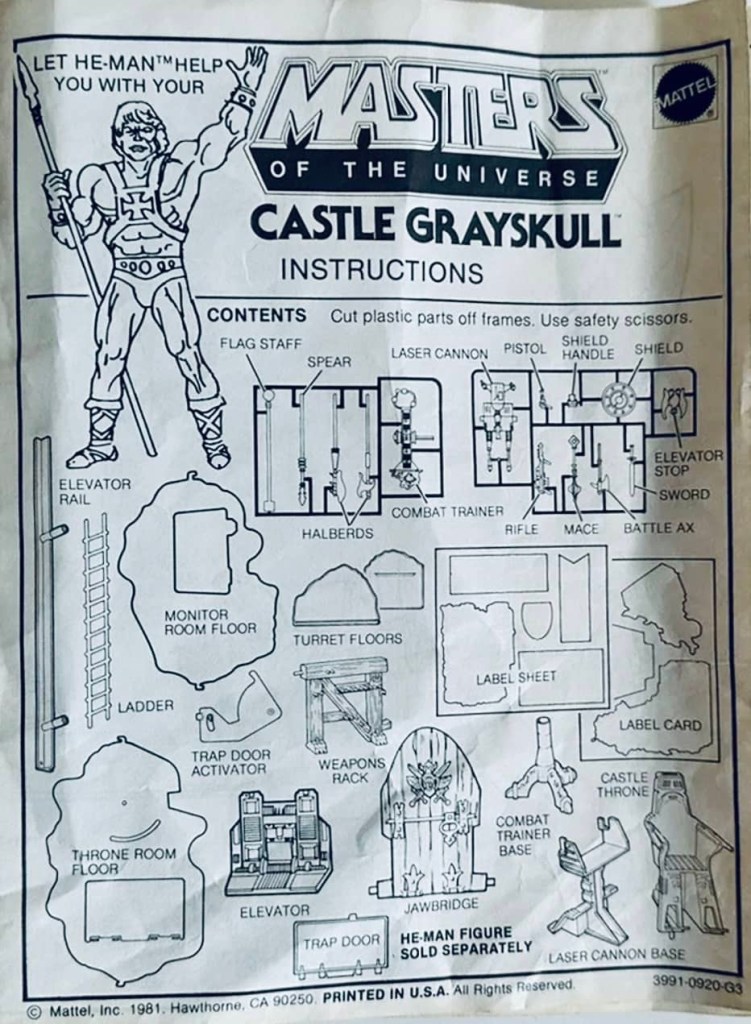
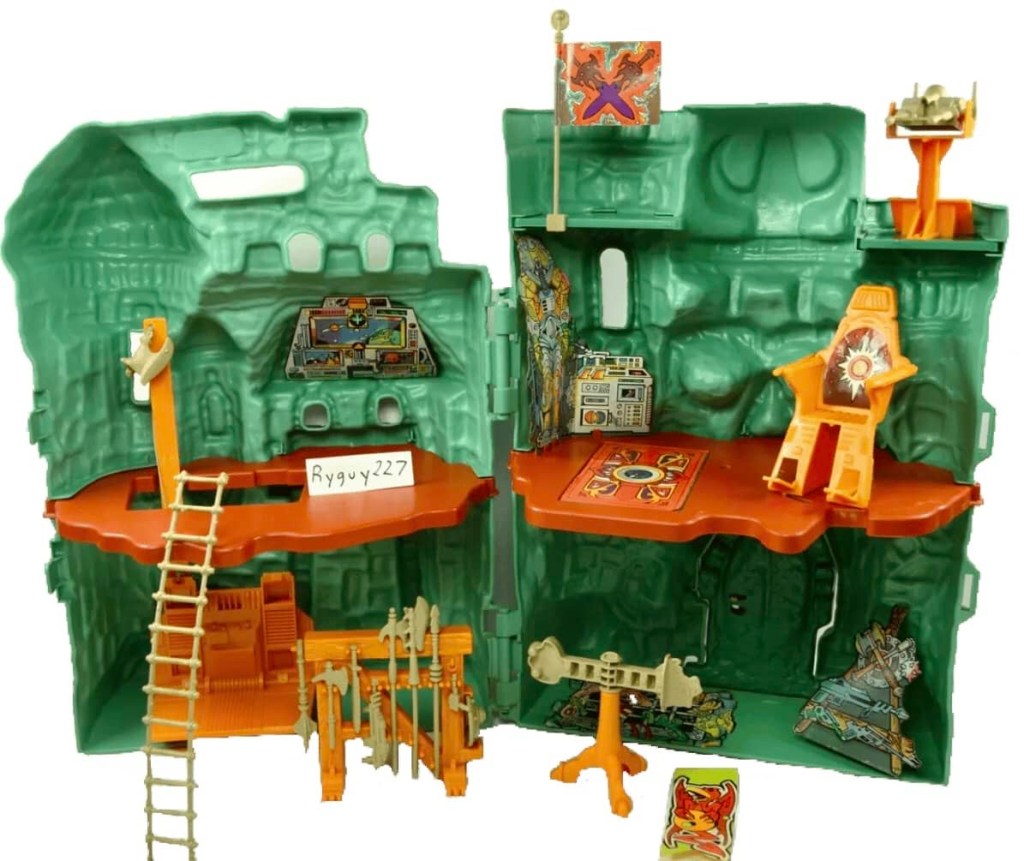
The original playset itself consists of two parts held together by hinges. This allows the castle to be closed for storage and to save space. It opens to reveal the inside and the outside of the castle. The exterior features a TON of amazing detail including stones, slates, windows, balcony, and of course the skull façade. Also on the front exterior are two towers. The taller is the watch tower where the flag is attached, while the smaller is the defense tower with a laser cannon that takes up most of the platform. The interior of the castle is pretty much divided into four sections. The first is the entrance hall and dungeon. This dungeon is represented by a simple sticker on the floor. There is also a combat trainer. Above the entrance hall is the throne room, which in my opinion, is the coolest room in the castle. There’s a trapdoor in the floor, decorated with a carpet sticker, which can be activated by shifting the throne. There is also a space suit looking carboard insert that could be a suit of armor. Behind the throne hangs a cool looking banner.

On the other half of the castle, the bottom floor is the armory where you can find the elevator. There are two weapons racks that can be placed in the armory. the first is a yellow plastic rack with pegs that can hold nine light gray weapons — a mace, a laser rifle, an axe, a sword, a halberd, a spear, a pole axe, a pistol, and a shield. The other rack is just a cardboard standee. The elevator runs on a rail that is fixed to the case and operated by pulling a string which is attached a small gargoyle. This leaves very little free space on either of the two floors. The fourth and final section is sort of a control room area that is accessed from the elevator. This room has a cardboard insert of a computer and monitor screen. There was little to actually put together on this playset, so it’s really just a matter of where you want to place the interior accessories.

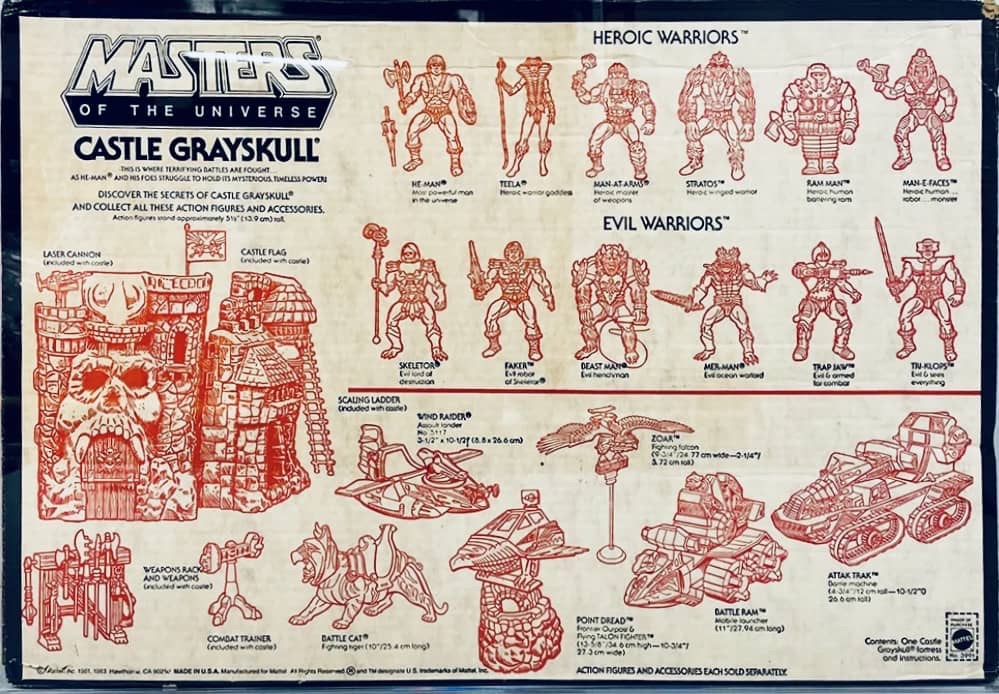
In total, the Castle Grayskull Playset included a Weapons Rack, Mace, Battle Ax, Sword, Halberd, Scythe, Spear, Shield, Ladder, Space Suit Cardboard Insert, Computer Cardboard Insert, Weapons Rack Cardboard Insert, Flag, Combat Trainer, Pistol, Laser Rifle and the Laser Cannon. The artwork on the box was absolutely stunning, and done by Rudy Obrero, who did most of the artwork from the early releases of Masters of the Universe line.

If action figure playsets had a Mount Rushmore, then the Castle Grayskull playset would certainly be on it. I know the word “Iconic” is used far too much in this world, but how can you honestly argue this playset isn’t exactly that! Castle Grayskull sold at a reasonable price point for the time and there were a LOT of these sold back in the day. Despite that, it remains incredibly popular with fans and collectors nowadays. Boxed Versions of the Castle Grayskull Playset can still be found on the secondary market but they won’t likely come cheap. Loose sets are much easier to find, but will probably be missing some of the individual pieces and accessories. Some of these loose individual playset pieces can sell for big bucks and it gets costly to put together a complete loose set. Obviously, graded or sealed versions will sell for higher prices when available. This really is a centerpiece item for just about any toy collection. It’s not overly big, but still big enough to catch someone’s eye. The playset worked really well, and provided hours of entertainment for children of that era. The Castle Grayskull Playset was fun, colorful, detailed and just plain impressive looking. Mattel created some amazing pieces for their Masters of the Universe line, but Castle Grayskull sits atop my list and remains one of the most truly ICONIC playsets created from the decade of the 1980’s.

We hope you enjoyed this TOY SPOTLIGHT! Be sure to check out our other Toy Spotlight articles from past months, Thanks.

Toy Spotlight – Batman’s WAYNE FOUNDATION by Mego
Toy Spotlight TMNT TECHNODROME by Playmates
Toy Spotlight – Transformers FORTRESS MAXIMUS by Hasbro
Toy Spotlight – Star Trek USS ENTERPRISE PLAYSET by Mego
Toy Spotlight – GI Joe USS FLAGG by Hasbro
Toy Spotlight – Six Million Dollar Man Action Figure by Kenner
Toy Spotlight – Star Wars EARLY BIRD CERTIFICATE by Kenner

TOY SPOTLIGHT ARCHIVE PAGE

The Toy Spotlight section focuses on iconic vintage toys, which truly moved the needle in the toy industry, and are recognized as true classics by collectors.

Since our Toy Spotlight section has grown, we have gathered older Spotlight Posts on this ARCHIVE PAGE for quick and easy viewing.


Toy Spotlight –
Star Trek USS Enterprise Playset by Mego


Toy Spotlight –
Six Million Dollar Man Action Figure


Toy Spotlight –
Star Wars Early Bird Certificate


Be sure to check out our other Toy Spotlight articles from past months!

Toy Spotlight Masters of the Universe Castle Grayskull by Mattel
Toy Spotlight Batman’s WAYNE FOUDNATION by Mego
Toy Spotlight TMNT TECHNODROME by Playmates
Toy Spotlight – Transformers FORTRESS MAXIMUS by Hasbro
Toy Spotlight – Star Trek USS ENTERPRISE PLAYSET by Mego
Toy Spotlight – GI Joe USS FLAGG by Hasbro
Toy Spotlight – Six Million Dollar Man Action Figure by Kenner
Toy Spotlight – Star Wars EARLY BIRD CERTIFICATE by Kenner
Batman’s Wayne Foundation (Mego – 1977)

A Landmark Playset by Mego!

This Toy Spotlight focuses on an iconic playset from Mego, and an item that sat atop the wish list of many kids back in the late 1970’s. Mego’s World’s Greatest Super Heroes line was a MASSIVE hit at the time, to say the least, and enjoyed worldwide success. Mego certainly gave us plenty of figures and accessories for the line, but their playsets were simply amazing! (Star Trek Enterprise, Bat Cave and Planet of the Apes Tree House to name a few). By 1977, Mego was the undisputed king of the toy world, so they could afford to take some risks, and boy did they ever! Mego released the largest item ever produced for the World’s Greatest Super Heroes line…….. and it was a good one. So without further ado, I humbly present Mego’s Wayne Foundation Playset from 1977.

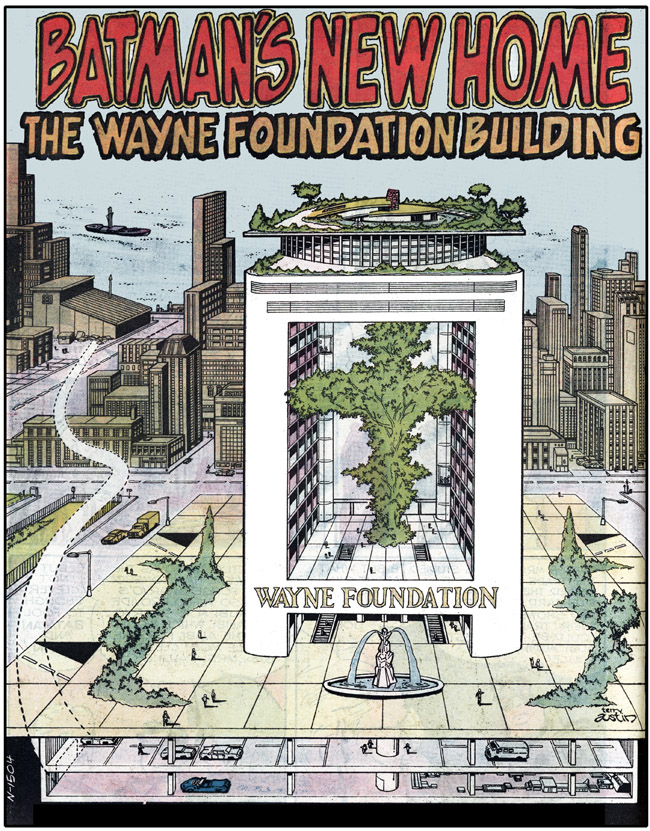
Mego certainly went heavy on the Batman action figures and accessories, and why wouldn’t they! Batman was insanely popular, with reruns of the 1960’s show, a successful animated series and of course, several best selling DC Comics. Batman was also among Mego’s best selling action figures, along with all things Batman selling extremely well. They had already made the Bat Mobile, Bat Copter, Bat Cycle, Mobile Bat Lab, Joker Mobile and Bat Cave, not to mention numerous versions of Batman related action figures. It looked like Mego was starting to run out of ideas for Batman items, so they borrowed an idea from the DC Comic world. Neal Adams’ Batman storyline at the time was trying to separate itself from the 60’s show and take Batman back into the “Dark Knight” detective storylines. Robin was off to college and Batman was running solo. Because of the new storyline, Bruce Wayne took up residence at the Wayne Foundation in Downtown Gotham. Penthouses and offices were on top, with secret labs and Bat rooms below. The guideline for the Wayne Foundation Playset was literally the Barbie Dream House and Neal Adams Studios helped design the playset, as well as the artwork for the décor, wall panels and packaging.

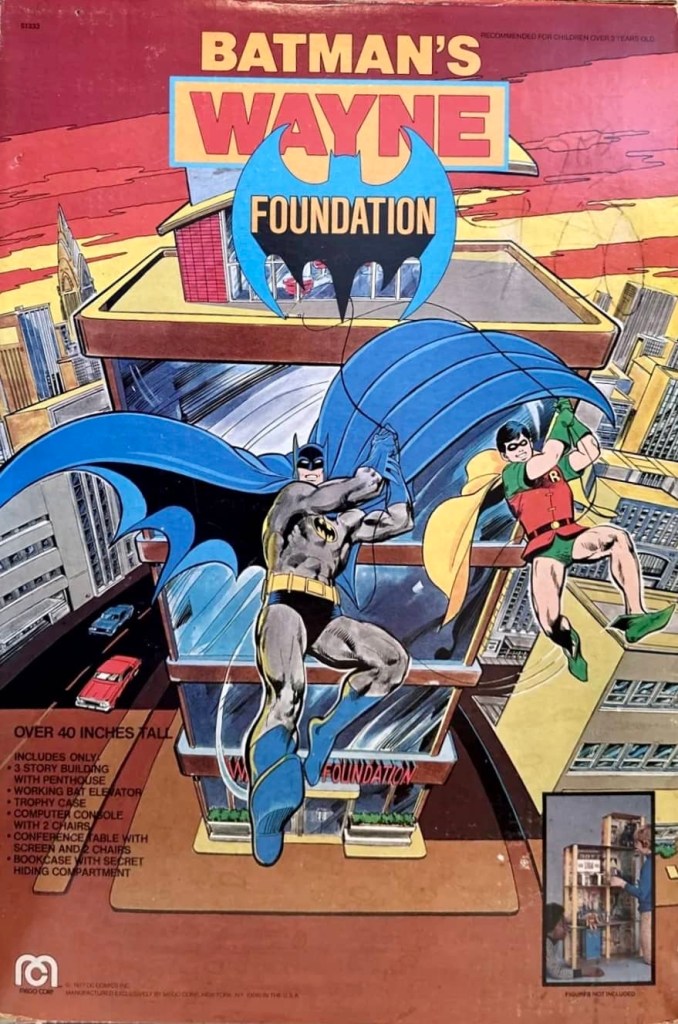
Of all the amazing and well-done playsets released for Mego’s WGSH line, the Wayne Foundation Playset stands alone as not only the biggest accessory made, but also among the most fun. Standing at a whopping 40 Inches tall and nearly Two Feet wide, this thing really had it all. There were four levels of fun, a bunch of accessories and it even came with a working elevator.

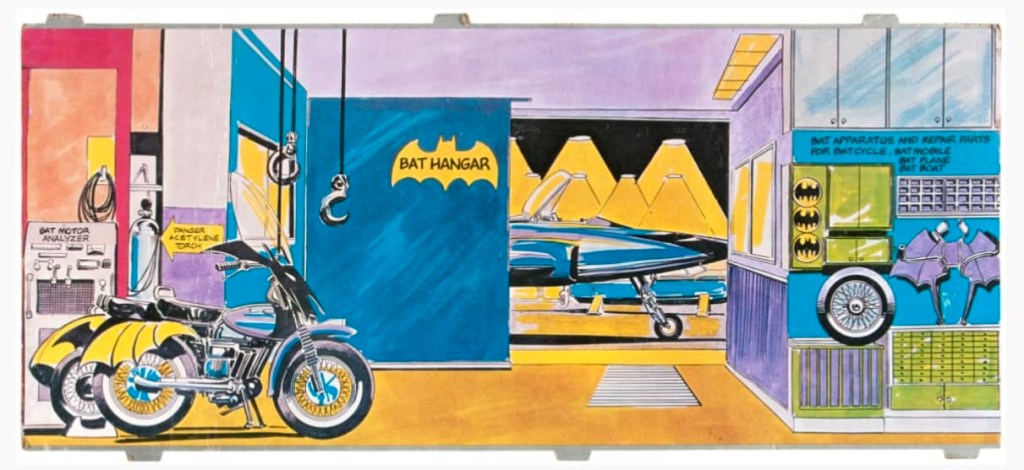
The playset was billed as a three story building with a penthouse (but isn’t that actually four stories?), anyway, starting at the top, the “Penthouse” was a secret room with a cardboard backdrop that was kind of science looking room with not much else. It was labeled a the “Bat Lab”. The next floor was the Hangar or Garage. This cardboard backdrop featured the Bat Plane, Bat Boat and Bat Cycle. There was also various repair tools and accessories painted onto the backdrop. Next is the Trophy Room. This is the iconic room that features all of Batman’s souvenirs and war spoils. On the cardboard backdrop, you can see the dinosaur and giant penny, along with a Man-Bat Portrait, Two-Face’s Coin, Giant Glass Eye, Cat Woman’s Whip, a Meteorite, Bat Mite Statue, and the Mad Hatter’s Hat Collection. This was always my favorite part of the playset. There were so many little Easter Eggs for fans and the artwork was gorgeous. The bottom floor acted as the Bat Lab or bad guy catching room. Even though the top floor actually says “Bat Lab”, this floor looks more like it. This is where the computer console would sit. The freestanding computer console itself is actually pretty darn cool because it features screen pictures of the Joker, Riddler, Lex Luthor and possibly Brainiac? The main photo on the bottom screen is the same one used for the Comic Action Heroes Superman Fortress of Solitude playset computer console with Superman, Green Arrow and others. Also included in the backdrop were all kinds of machines and gadgets to help Batman solve crimes and catch bad guys. The elevator stopped on all floors and ran on a cord that pulled it up and down. I won’t lie, the elevator instructions kind of read like an IKEA instruction manual, so I just winged it and it seemed to work fine.

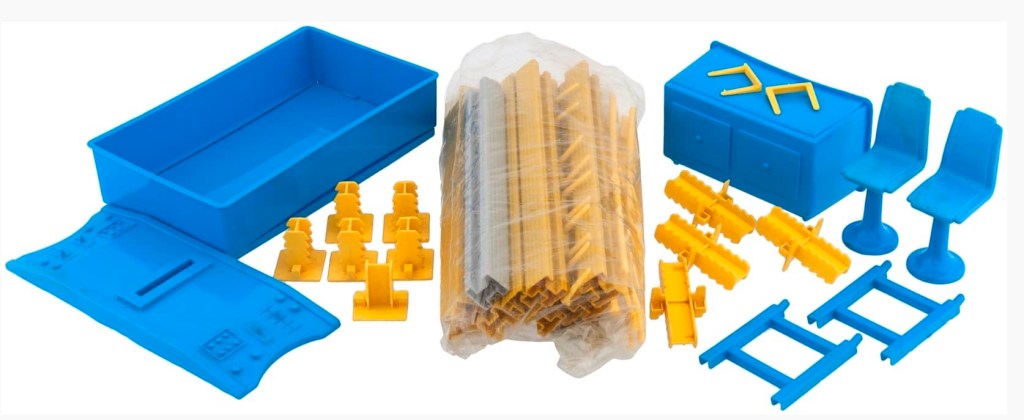
In total, the Wayne Foundation Playset included a Computer Console, Conference Table with Screen, Four Chairs, Trophy Case, Bat Elevator and of course…the Secret Bookcase. The bookcase had a sliding door that you could move to hide various parts of the playset, depending on where you wanted it on that particular day. The artwork on the box was beautifully done by Neal Adams, with a lot of nods to Batman history and lore. This really was the Barbie Town House for boys! Alas, the Wayne Foundation Playset marked the last of the great playsets for the 8″ figures, but at least Mego went all out on it.

The Wayne Foundation Playset was a bit of a gamble by Mego back in 1977, but is highly coveted by collectors nowadays. At an average price tag of around $17 – $20 (depending on where you bought your toys back then), and the large amount of space it took up on shelves, retailers weren’t exactly crazy about ordering bunches of these for their stores. As a result, there weren’t a ton of them sold back in the day, which obviously affects its value now. Obviously, this playset remains extremely poplar on the secondary market, and boxed Versions of the Wayne Foundation can be tough to find. Even loose sets can be hard to track down, mostly due to all the individual pieces. Finding one at a reasonable price will likely prove a tough task and could require some patience. Loose versions range in value from $400 – $600, depending on condition and whether they are complete. Boxed versions can fetch up to $1,500 or more, again depending on the box’s condition and whether it’s complete. Obviously, graded or sealed versions will sell for higher prices. This really is a centerpiece item for just about any Mego collection. Despite its large size, it worked really well, and provided hours of entertainment for children of that era. The Wayne Foundation was big, colorful, awesome looking, full of Easter Eggs, great details and just plain fun. Big Kudos to Mego for giving us a fantastic toy that entertained us and captured our imaginations.

We hope you enjoyed this TOY SPOTLIGHT! Be sure to check out our other Toy Spotlight articles from past months, Thanks.

Toy Spotlight TMNT TECHNODROME by Playmates
Toy Spotlight – Transformers FORTRESS MAXIMUS by Hasbro
Toy Spotlight – Star Trek USS ENTERPRISE PLAYSET by Mego
Toy Spotlight – GI Joe USS FLAGG by Hasbro
Toy Spotlight – Six Million Dollar Man Action Figure by Kenner
Toy Spotlight – Star Wars EARLY BIRD CERTIFICATE by Kenner
Teenage Mutant Ninja Turtles – Technodrome (Playmates – 1990)

A look back at a Turtles Legend!

This Toy Spotlight focuses on a true icon in the world of the Teenage Mutant Ninja Turtles, and an item that sat atop many kids wish lists from back in the day. Playmate’s TMNT line was a MASSIVE hit at the time, to say the least, and enjoyed worldwide success. Playmates gave us plenty of vehicles and accessories for the line, but early on, only one large scale playset had been produced with the Sewer Playset in 1989. So in the following year, Playmates released the biggest Teenage Mutant Ninja Turtle toy of the action figure line, which is now considered a true toy classic. So without further ado, I humbly present Playmate’s Technodrome from 1990.

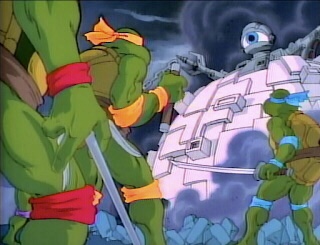
Shredder and his band of misfits acted as the main antagonists for the animated series and comics, and there were bunches of figures, vehicles and accessories created for the bad guys, but they didn’t have a base or headquarters until Playmates gave us the incredible Technodrome in 1990. The Technodrome made its debut in the first season of the TMNT animated series in 1987, and was featured in multiple episodes thereafter. It was originally designed by Krang, and built to be the ultimate war machine, although it did spend a lot of time not working correctly. With its foot thick titanium armor plating, trans-dimension portal, massive armory of weapons, unique structure and impressive size, the Technodrome was truly a nightmare for our favorite pizza chomping heroes, ready to dish out some serious turtle smackdown!

The toy itself was impressive looking , but not quite as big as you would’ve imagined it would be (972 rooms for the real deal). At just 15″ from top to bottom, Playmates packed a lot of stuff into that space. Besides, if they were to make this to actual scale of the action figures, the Technodrome would have been around 72 feet tall……which would be freakin’ awesome, but a tad difficult to fit in the house. Still, it was bigger than every other TMNT item produced by Playmates at the time, including the Sewer Playset. The Technodrome was billed as “The bulbous, burrowing battle base” and “the ultimate foot fortress”, and I would say it certainly checked all those boxes.

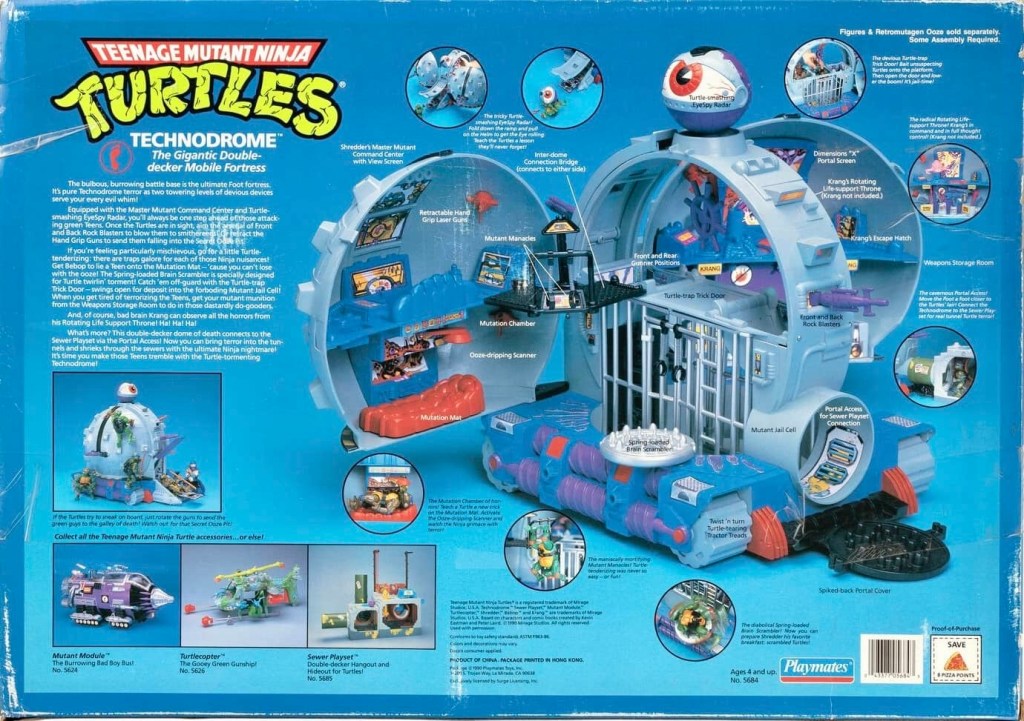
The central dome opened up into two halves. The inner playset was big and included two rooms in each dome half. On one side was Shredder’s Master Mutant Command Center w/ View Screen, the Mutation Chamber with Ooze-Dripping Scanner, Mutation Mat, and Retractable Hand Grip Laser Gun. The other half of the dome included the Front and Rear Gunner Stations (Figures wouldn’t fit well without being in awkward poses), Turtle-Trap Trick Door leading into the Mutant Jail Cell, Spring Loaded Brain Scrambler, Dimensions “X” Portal Screen, Krang’s Rotating Life-Support Throne, Krang’s Escape Hatch, and Weapons Storage Room. Between the two dome halves was the Inter-Dome Connection Bridge that connected one side of the playset to the other. Attached to the bridge were Mutant Manacles to suspend the turtles high above the ground. There was also a spiked back portal cover and a secret ooze pit with Shredder’s secret entrance that led into the mutant jail cell. Side Note: The Brain Scrambler fit into the base of the playset and would spin around when wound up.

The exterior of the Technodrome has a number of cool looking Hand Grip Laser Guns for mostly cosmetic purposes and also for figures to cling onto, along with Front and Rear Rock Blasters, which were essentially large guns. On either side were Turrets that point out and pivot on a hinge with a small purple platform. The drome base was large and obviously contained the track/wheels so the Technodrome could roll around on the floor (with that memorable & unique rolling sound). And finally, on the very top of the Technodrome was one of its most recognizable features, the Tricky Turtle Smashing Eye Spy Radar. This was actually my favorite part of the playset because your eye (no puns intended) is automatically drawn to it. Another super cool feature of the Technodrome was the Portal Access for connecting to the Sewer Playset, kind of like a big hamster environment with connecting tunnels.

The Technodrome was a bit of a gamble by Playmates back in 1990, but is highly coveted by collectors nowadays. At a price tag of $49.99 back then and the large amount of space it took up on shelves, retailers weren’t exactly crazy about ordering bunches of these for their stores. As a result, there weren’t a ton of these sold back in the day, which obviously affects its value now. It remains extremely poplar on the secondary market, but this is not necessarily a “difficult” item to find. There are generally several listed at any given time, but finding one at a reasonable price may prove a tougher task. Loose versions range in value from $200 – $400, depending on condition and whether they are complete. Boxed versions can fetch up to $1,000, again depending on the box’s condition and whether it’s complete. Obviously, graded or sealed versions will sell for higher prices. This really is a centerpiece item for just about any collection. Despite its large size, it worked really well, and provided hours of entertainment for children of that era. The Technodrome was big, awesome looking, full of traps, plenty of weapons, great details and just plain fun. Kudos to Playmates for giving us a fantastic toy that entertained and captured our imaginations.

We hope you enjoyed this TOY SPOTLIGHT! Be sure to check out our other Toy Spotlight articles from past months, Thanks.
Toy Spotlight – Transformers FORTRESS MAXIMUS by Hasbro
Toy Spotlight – Star Trek USS ENTERPRISE PLAYSET by Mego
Toy Spotlight – GI Joe USS FLAGG by Hasbro
Toy Spotlight – Six Million Dollar Man Action Figure by Kenner
Toy Spotlight – Star Wars EARLY BIRD CERTIFICATE by Kenner

Transformers – Fortress Maximus (Hasbro – 1987)

A look back at a Transformers Icon!

This Toy Spotlight focuses on a true legend in the Transformers world and an item that sat atop many kids wish lists from the late 1980’s. Hasbro’s Transformer line was a huge hit at the time, to say the least, and was enjoying massive success in the North American market, as well as overseas. It would’ve been easy for Hasbro to play it safe with what had already been working, but in 1987, they released the largest Transformer toy of the entire G1 toy line, which is now considered a Transformer toy classic. So without further ado, I humbly present Hasbro’s Fortress Maximus from 1987.

In 1984, Hasbro Toys had gained a real foothold in the action figure market with their newly revamped GI Joe 3.75 inch line. The Joe line became a massive global success, but Hasbro still wanted more and ended up going across the world to get it. A Japanese toy company called Takara had been making transforming robots and vehicles since 1980 under the Diaclone line. Each of the vehicles were controlled by a miniature pilot called Micro Man. In 1982, Takara combined the robots and vehicles into what we now know as Transformers. Hasbro, realizing the massive potential of this toy line, quickly jumped on the North American toy licensing rights to this line and went into production of a slightly revamped Diaclone line simply called, the Transformers. The toy line was released in 1984 and became an instant smash hit! The toy line was such a success that it spawned a hugely popular comic by Marvel Comics and one of the biggest animated series ever released on television.

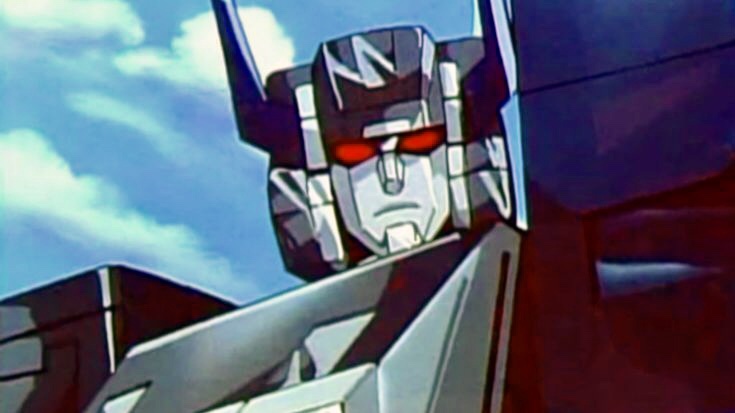
Fortress Maximus made his debut in the final episode of the Transformers animated series in 1987, which was Part 3 of “The Rebirth” miniseries. He was constructed by Spike Witwicky and Cerebros from an old Nebulan city. He was a giant Autobot capable of transforming into a battle station, under their control as part of the Headmasters. Fortress Maximus travelled to Cybertron where he battled the similarly giant Scorponok and then the rest of the Decepticons, driving them off the planet. Afterwards, he returned to Nebulos. He was voiced by Stephen Keenan in the show, who spoke Fortress’ one and only line from the series, “Decepticons… prepare to face … Fortress Maximus!

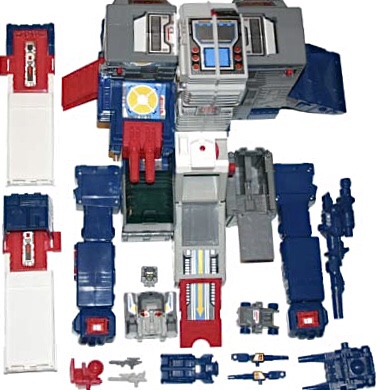
The toy itself was impressive and just plain big! At 22″ tall, it dwarfed every other G1 Transformer produced by Hasbro at the time, including his nemesis, Scorponok. It was heavy too, weighing in at a hefty 11 pounds. Fortress Maximus was billed as being able to transform from robot mode to battle station mode to city mode, and back again. While in Battle Station mode, there wasn’t a whole lot of playability or articulation. It had several weapons all around, along with Spike in the cockpit tower. In this mode, Gasket and Grommet came out of where his feet were. Side Note: Gasket and Grommet come together to form Cog. On the other side of the Battle Station, you can find Cerebros, who is the gray shape near the radar dish. He transforms into his robot form, but with no head. That’s where Spike comes in, as Spike transforms into his the head of Cerebros and attaches to the body (Hence the name, Headmasters). From there, Fortress could be switched to City Mode.

To get to City Mode, there were a long series of moves that have to be made, and trust me, they do take some effort. Once in City Mode, Fortress Maximus is still pretty darn big with a lot more moving parts and playability than in Battle Station mode. For instance, underneath the Heli-Pad is a door that opens to reveal a jail cell. On the other side is a Repair Bay that opens up to store smaller vehicles. If transformed correctly, there will be a tunnel through the middle of the City. The small vehicles can fit inside and rise to the top on an elevator, then shoot out from the front middle ramp. The two front side ramps are also launchers that can propel smaller vehicles. The last transforming mode is the classic Robot Mode.

Once again, there are several moves that have to be made to get to Robot Mode, and once again, it requires some work to get to. Basically you are placing Fortress back towards his Battle Station Mode, and then some. Once that mode is completed, Cerebros will be transformed into the head of Fortress Maximus. Spike can be pulled off Cerebros at this point, as he is no longer really needed for this function. In this Robot Mode, he reaches his full height of over 22″ with lots of moving parts and hidden weapons. In my opinion, this is the way Fortress should be displayed just due to his impressive size. Despite that massive size, Fortress still has pretty decent range of motion and articulation.

Fortress Maximus was a huge gamble by Hasbro back in 1987, but is highly coveted by collectors nowadays. Due to its nearly $100.00 price tag back then, there were not a lot of these sold back in the day, which obviously affects the secondary market value. The good news is that any Transformer collector probably has Fortress Maximus at the top of their wish lists, and boxed versions are considered “Holy Grail” items. It remains extremely poplar on the secondary market, and they quickly disappear when they do pop up. Loose versions range in value from $200 – $400, depending on condition and whether they are complete. Boxed versions are not as easily found, and can range from $1,200 to $2,000, again depending the box’s condition and whether it is complete. Obviously graded versions will sell for much higher. Hasbro really loved their giant show stoppers for their toy lines (Defiant and U.S.S Flagg for the GI Joe line) which makes them centerpieces for just about any collection. Fortress Maximus is genuinely considered an all-time classic from the Transformers line. Despite its gigantic size, it worked really well, and provided hours of entertainment for children of that era. A big thank you goes out to Hasbro for their creative ingenuity in putting this classic together and shaping an incredible era of toys, not to mention having the stones to release something this massive.

Star Trek – U.S.S Enterprise Playset (Mego – 1974)

A look back at an action figure classic!

This Toy Spotlight focuses on a true legend in the action figure industry, and an item that many kids had from the 1970’s. When Mego launched their Star Trek toy line in 1974, it was an instant hit. The first wave of items included a few action figures, accessories and one gloriously fun playset. That playset, made for the 8 inch figures, is now considered a iconic toy classic. So without further ado, I present Mego’s U.S.S Enterprise Playset from 1974.

By 1974, Mego Toys was quickly becoming a global name in the toy industry. With the World’s Greatest Heroes line already proving to be a huge success, Mego turned their sights on other licenses from the the big and small screens. The original Star Trek television series ran from 1966 to 1969 and spanned 79 episodes. In late 1969, Star Trek began running syndicated episodes in over 200 markets, which sparked a huge revival of interest in the show. Star Trek became so big, the original actors returned to voice their characters in an Animated Series from 1973 to 1974. Mego took notice of this, and quickly signed Star Trek to a licensing deal for a very reasonable price. Mego had high hopes for the line from the very beginning, and their attention to detail really showed with the first wave of figures and accessories. Since Star Trek Mania was at a fevered pitch, the Star Trek action figure series turned out to be one of the biggest selling lines that Mego ever produced. It did well enough that additional waves of figures and accessories were released in following years.

The first wave of Star Trek items included five action figures, and a few roleplay accessories such as the Communicator set, a Tricorder, and of course, the Enterprise playset. The Enterprise was arguably the most successful and best selling playset that Mego had ever created, depending on who you ask. It was available in abundance due to massive production numbers by Mego, but you can’t really blame them. Despite the large production runs, it still sold extremely well. The U.S.S Enterprise Action playset was the first one released for the Star Trek line, and would go on to become an icon of that era of toys. The playset itself was not incredibly accurate to the actual bridge from the Enterprise, but it definitely captured the spirit of it, and it was just plain fun.

The Enterprise playset itself could be folded up into a neat and tidy carry case, complete with a handle on top. The set included a computer console with two crew member stools and of course, the captain’s chair. Also included were three different two-sided viewer screens that could be manually changed out. The Enterprise set was basically broken down into three different areas of the ship. The main part was of course, the bridge. This is where you could set up the computer and chairs, along with the view screens. This was the largest area, and could easily accommodate several Star Trek figures. There was a small room to the right of the bridge, which is identified as the “Engine Room”, but has no accessories. The final section of the playset also happens to be the absolute coolest part of it, the transporter room. A figure would be placed inside the transporter, and then you would spin it by using the spin button on top of it. Then you mash the stop button, and the transporter would come to a sudden stop. Just like that, the figure would disappear…..….or at least be on the other side of the transporter.

A “Gift Set” version of the Enterprise also exists, and came in a yellow box. The Gift Set is basically identical to the regular version, but includes the first five figures (Kirk, Spock, McCoy, Scottie, Klingon), and that’s about it. A separate “Transporter Room” was also offered overseas by the Mego subsidiary, Palitoy. This was essentially the same transporter as the one inside the playset, but sold separately. It was actually a nifty piece to have, especially when you wanted to re-create “transporting” from the Enterprise to a planet surface or another ship.

Mego’s U.S.S Enterprise Playset was a huge hit back in the mid 1970’s, and is highly coveted by collectors nowadays. There were a LOT of these sold back in the day, which obviously affects the secondary market value. The good news is that any collector of Mego or Star Trek needs one of these in their collection. It remains extremely poplar on the secondary market, and still brings good prices. Loose versions of the Enterprise playset can be easily found, and usually sell for affordable prices. Boxed versions can also still be found, but are getting harder and harder to find in a decent shape. Mego really set the bar high for future playsets, and the Enterprise is genuinely considered an all-time classic. Mego’s USS Enterprise remains the gold standard for what a successful action figure playset looks like. Despite its simplicity, it worked really well, and provided hours of entertainment for children (myself included) from that era. It still holds up extremely well, and if you don’t believe me, just ask my kids who loved making their more modern action figures disappear in the transporter room while playing with it. A big thank you goes out to Mego for their creative ingenuity in putting this classic together and shaping an incredible era of toys.

U.S.S Flagg – Aircraft Carrier (Hasbro – 1985)

The largest action figure playset ever created!

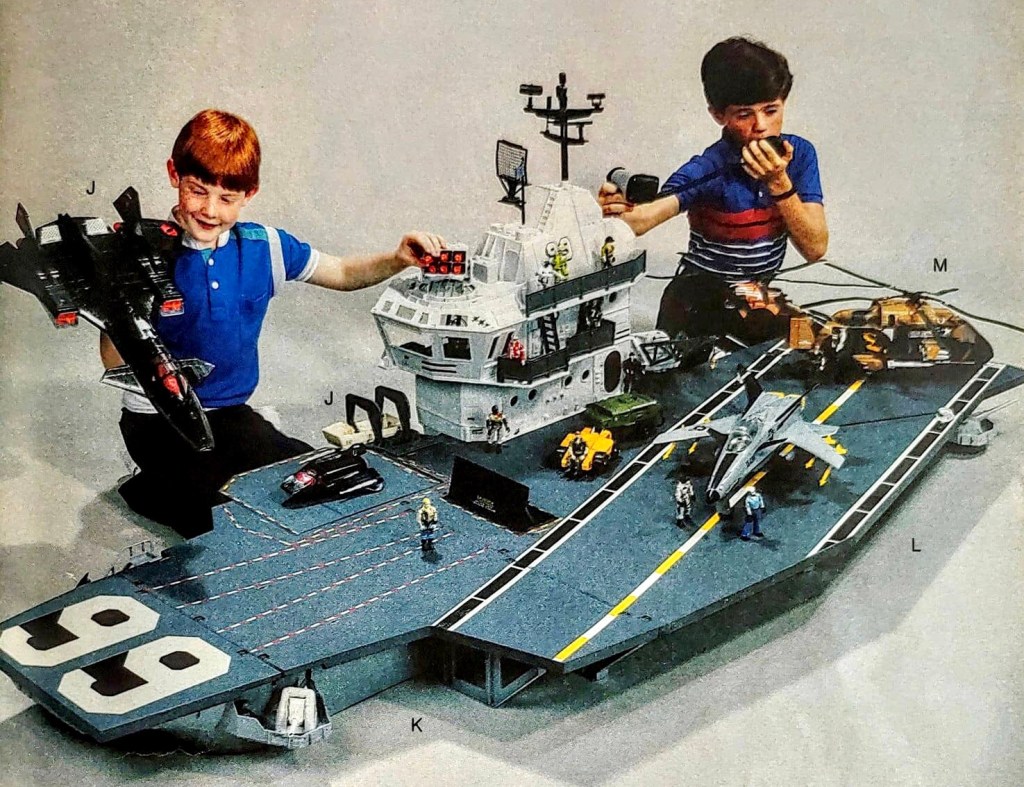
This Toy Spotlight focuses on a true action figure icon, and an item that sits atop the wish lists of many collectors. When Hasbro re-booted their GI Joe line in 1982, the one significant change it made was to shrink the figures down to a more economical 3.75 inch size. In addition to being cheaper to produce, it also gave Hasbro the flexibility to create a ton of amazing vehicles and playsets for their new sized figures. The smaller size allowed Hasbro to get really creative in putting together a cohesive GI Joe world, complete with all the bells and whistles. So, in 1985, Hasbro took a big gamble and released the largest action figure playset EVER created. Without further ado, I present Hasbro’s U.S.S Flagg Aircraft Carrier Playset from 1985.

They say that you can’t keep a good man down, so GI Joe made his triumphant return to toy shelves everywhere in 1982. The best part about the smaller sized figures, was that it opened the door for a ton of great vehicles, playsets and accessories. The older 12 inch figures had vehicles and limited playsets as well, but they were a bit clunky with not a lot of detail. The new 3.75 inch size allowed Hasbro to dive deep into just about everything the military had to offer, including tanks, jeeps, bikes, jets, helicopters, personnel carriers, and ships. Hasbro was testing the waters (no pun intended) with each new wave of Joe products, with more detail and grander scale each year. With all the new Joe figures and accessories, there was an big need for large scale playsets, and those playsets show the biggest evolution of the entire Joe line. Hasbro’s first released playset was a very standard and plain cardboard set called the Missile Command Headquarters in 1982. This was followed by the extremely cool GI Joe Headquarters Command Center in 1983, and none in 1984.

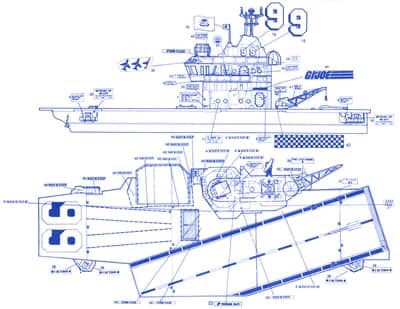
By the year 1985, GI Joe was firmly established as one the top selling toy lines in the entire world, and riding a massive wave of popularity. Hasbro could now afford to take a few chances with different types of ideas and get creative. One of those big ideas (no puns intended) was the U.S.S Flagg (CVN-99). It was proposed the year prior, and got the green light after the Joe line posted massive sales numbers in 1984. The Flagg was a traditional aircraft carrier, modeled after the real life, U.S.S. Nimitz. Hasbro knew they had to make the carrier big because of the already large sized vehicles that would be on it, such as the Skystriker jet. If it was built to true scale with the rest of the Joe figures and vehicles, the Flagg would’ve been nearly 65 feet long and 13 feet wide. As amazing as that sounds, it just wasn’t going to happen. The final size of the U.S.S Flagg ended up being 7 feet and 6 inches long, just over 3 feet wide, and almost 3 feet tall. That may not be 65 feet, but it was still absolutely HUGE for an action figure playset at the time, or any time for that matter. In fact, it would be the largest item ever created for any action figure line, and remains so to this day.

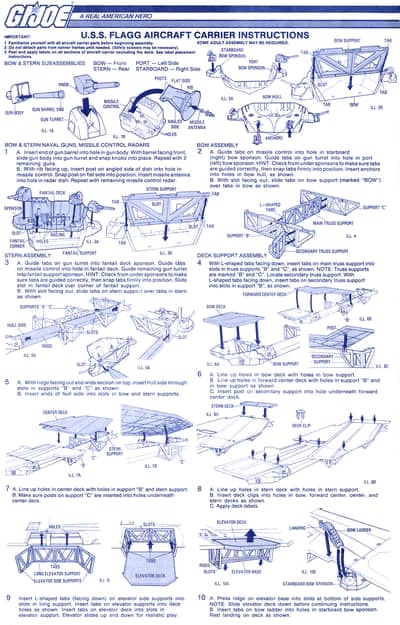
When the U.S.S Flagg hit the toy shelves, it retailed for $109.99. That’s a steep price to pay for a playset in today’s world, so you can imagine how that felt in 1985. For obvious reasons, the Flagg was produced in more limited quantities than other GI joe vehicles and accessories of the time. Any child who grew up in the 1980’s immediately wanted this, as soon as we saw it in the store catalogs. This was, without a doubt, one of the most iconic toys of the entire GI Joe line. At first glance, the box for the U.S.S Flagg was huge. Once you dumped all the pieces out, and took a glance at the mini novel instructions, you instantly knew that your work was cut out for you to put this thing together. The main deck came in four large plate pieces, that fit onto the main bow support. If you go by the instructions, you will have to assemble several other pieces before you get to putting the main deck together. To say this thing had a lot of small pieces for assembly would be a MASSIVE understatement. I’m very sure that many parents back in the 80’s struggled to put this together. This assembly can be a bit overwhelming, but just focus on the ultimate prize of seeing the Flagg in all of its glory, sitting on your dining room table!

When completely assembled, the U.S.S Flagg really comes to life, with all of its detailed pieces and features. The ship came with a two-piece vehicle, which was a tow vehicle and fuel trailer. It also included multiple radar dishes, missile launchers, cannons, an elevator deck, arrestor cables, and an admiral’s launch ship. One of the more awesome features of the Flagg was the electronic public address system. This was basically a bullhorn hooked up to a speaker, that allowed kids to speak into it and have their voice projected around the room, just like being on board the ship. The PA system also played various battle sounds to simulate those classic fights with Cobra. The commander of this incredible ship was Vice-Admiral Keel-Haul, who was included with the Flagg. Even though the U.S.S Flagg was featured in both, the comics and animated series, Keel-Haul never was. This ship also later inspired the Joe figure of General Flagg, released in 1992, who was the son of the original commander of the U.S.S Flagg.

Hasbro’s U.S.S Flagg Aircraft Carrier was a tough sell back in 1985, but is highly coveted nowadays by GI Joe fans around the world. I would guess that it sits near the top of any Joe collectors “Holy Grail List”. The problem is, this item doesn’t come up for sale very often in its original box, and will cost a small fortune when it does. Even loose and incomplete versions of the Flagg go for big dollars on the secondary market. With all due respect to Kenner’s Star Wars line, Hasbro really set the bar when it came to vehicles and playsets for 3.75 inch figures. They created an incredible world for their figures to play in, and brought lots of fun to their GI Joe line. In a business abound with new innovations and creativity, it can be difficult to stand out and truly move the needle, but that’s exactly what Hasbro did with the U.S.S. Flagg. It wasn’t just a huge playset, it was a game changer. No one had ever seen anything like this before, and to be honest, I highly doubt anyone would ever try again. This was absolute joy, stuffed into a massive box, and anyone who was/is lucky enough to own one of these, must have really done something good in their life.

The Six Million Dollar Man (Kenner – 1975)

The Bionic Man makes the jump to action figures!

This week’s Toy Spotlight article focuses on another action figure pioneer from the 1970’s. During that era, the toy market was changing in a big way, and really beginning to take shape. Television and movie stars, along with pop celebrities were making the big jump into the toy world. With that in mind, there was no bigger television show on the air in 1975 than the Six Million Dollar Man. It was time for the Bionic Man to crush the toy market just like Colonel Steve Austin crushed bad guys on the small screen. So this Toy Spotlight is on, Kenner’s Six Million Dollar Man action figure from 1975.

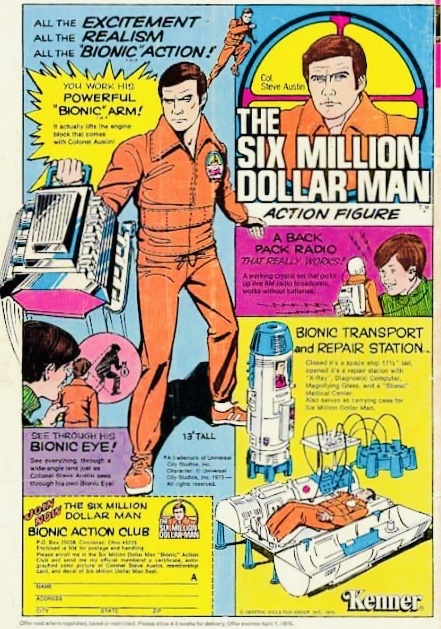
In all started back in 1973 when the ABC television network decided to take a chance on a new TV series. It was based upon a book series called “Cyborg”, which was written by Martin Caidin. Instead of going with the book title, ABC decided to change it to The Six Million Dollar Man. The 90 minute pilot episode debuted on March 7, 1973. The show and its star, Lee Majors, would go on to become a smash hit and gained international success. It seemed a no brainer that a toy line would come from this hit series, and the Kenner Toy Company was the lucky one to secure that license. Kenner released their Six Million Dollar Man line in early 1975, and to say it was a huge success would be an understatement. Since the show was already an international hit, so were the toys. They sold out on toy shelves across the globe and became an instant classic.

Television and Movie action figures had certainly been done before the Six Million Dollar Man came to town. Mego made it a popular trend with their Star Trek, Planet of the Apes, and Wizard of Oz action figure lines. Even before that, we saw toy lines from major 1960’s brands such as Bonanza, Man From UNCLE, Batman, and even James Bond. On its own, action figures from a TV show weren’t that unique, but the Six Million Dollar Man was a Bionic Man with cybernetic parts, so he was ready made for a super cool action figure. Hasbro’s GI Joe toy line had upped their game in the early 70’s with their Adventure Team, and began producing new types of inventive figures. Kenner decided they needed to do the same by making their Six Million Dollar Man figure unique, and adding their own special features.

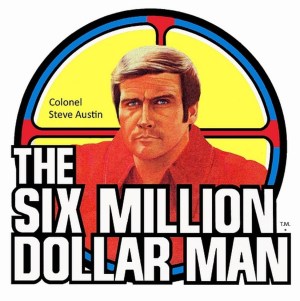
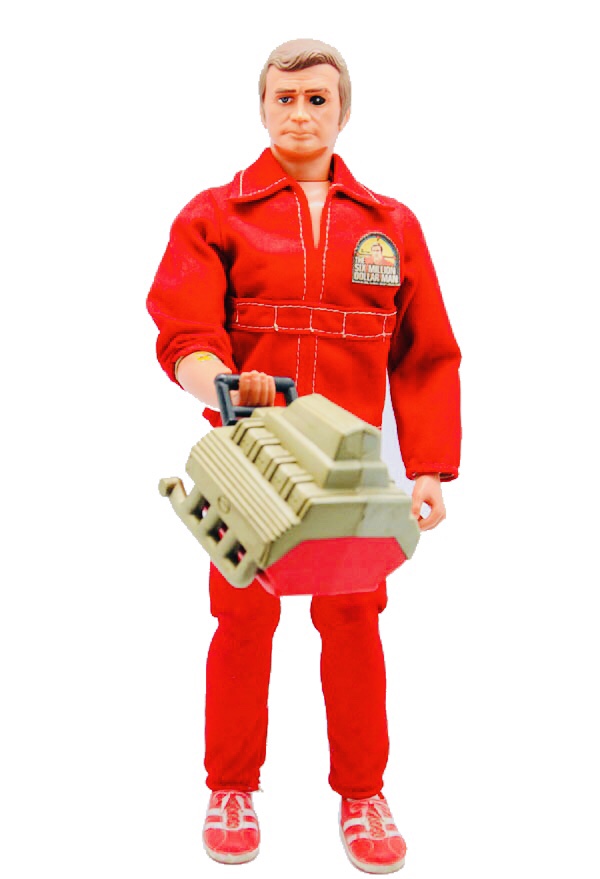
Any child who grew up in the 1970’s, either had this figure or wanted to have it. This was, without a doubt, one of the most iconic toys from that era. At first glance, the Steve Austin figure came with his classic two piece red jogging outfit, along with red sneakers (no socks). In case he ever forgot who he was, there was a patch on the left side of his chest with the Six Million Dollar Man logo. The head sculpt was pretty spot-on, with an excellent likeness of the actor, Lee Majors. His main included accessory was a plastic molded engine block (more on that later). All of that was well and good, but the real thing that made this figure stand out from the pack were his many special features. Among those many features was a telescoping eye that would allow you look through the back of his head, and see whatever the figure was seeing in front of him. Steve also had a super strength feature that used the car engine block accessory. This allowed Colonel Austin to lift up to two pounds by simply pushing a button on his back (note: his head needed to be turned to the right to make this happen). When the button was pushed, It even made bionic sounds! There was a thin rubber “skin sleeve” that could be rolled up on his arms that exposed the Bionic panels underneath. This was a simple but incredibly effective way to convey the bionic/cyborg part of the figure.

Two more versions of the Six Million Dollar Man figure would be released in the following years. The second version had the same Steve Austin character with red jogging suit, but he now had a Bionic Grip to clamp down on items. The third and final version featured Steve Austin in a different red outfit altogether, with a Supersonic feature, which was basically a super Karate chop. Even though these other figures were nice, they just weren’t the original OG real deal Six Million Dollar Man that all know and love. Kenner also released multiple accessories, playsets and vehicles to go along with its star toy line, along with a load of various non-action figure items such as Play-Doh sets, Movie Viewer, Give-A-Show Projector and much more.

Kenner’s Six Million Dollar Man series was incredibly popular back in the 1970’s, and remains highly collectible in today’s market. From that series, the Steve Austin/Bionic Man figure stands out as one of the best examples of original ingenuity in the toy industry. The creation of this line by Kenner ushered in a new wave of creativity, and brought lots of fun to their Six Million Dollar Man line. This creativity would also carry over to other future Kenner brands, such as Star Wars. Over the course of this article, I’ve listed many reasons as to why the the Bionic Man figure stood out, and became such an iconic piece of toy nostalgia. The biggest truth as to why this figure stands out so much, was that it was just so darn to play with, and that is a formula not easily duplicated in the toy world.

Notice the Six Million Dollar Man action figure behind Lee Majors in this scene from the show!

Star Wars Early Bird Certificate (Kenner – 1977)

A Legend is Born!

For my very first Toy Spotlight article, I wanted to focus on something that changed the way modern toy lines are created and sold. An item that was not only a pioneer in the action figure industry, but a true game changer in retail. There are certainly many to chose from, but in the end, I went with the one that changed my life personally. So without further ado, I humbly present Kenner’s Star Wars Early Bird Certificate from the Holiday season of 1977.

When George Lucas began shopping around for a company to distribute products and toys from his new Science Fiction movie called Star Wars in 1977, nobody seemed too interested. Mego Toys had famously passed on the opportunity, but a small company named Kenner Toys decided to take a chance on it. At that point, Kenner was most known for Easy Bake Oven, Lite Brite and the Six Million Dollar Man line. Once the movie actually hit theaters, Star Wars took everyone by surprise with its immense success, which put Kenner in immediate scramble mode for new products. Due to their late start, Kenner had only produced a handful of items for 1977, such as puzzles, bop bags and a board game. They still wanted to get something out to the public to showcase their upcoming action figure line for the holiday season, thus, the Early Bird Certificate was born.
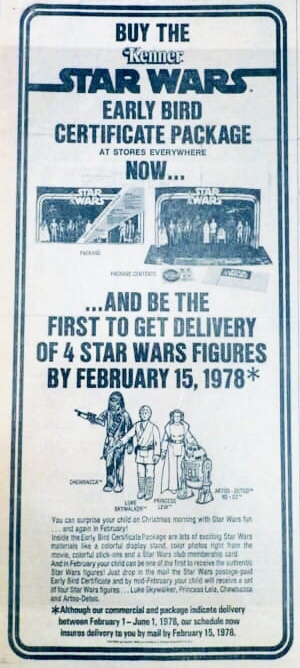
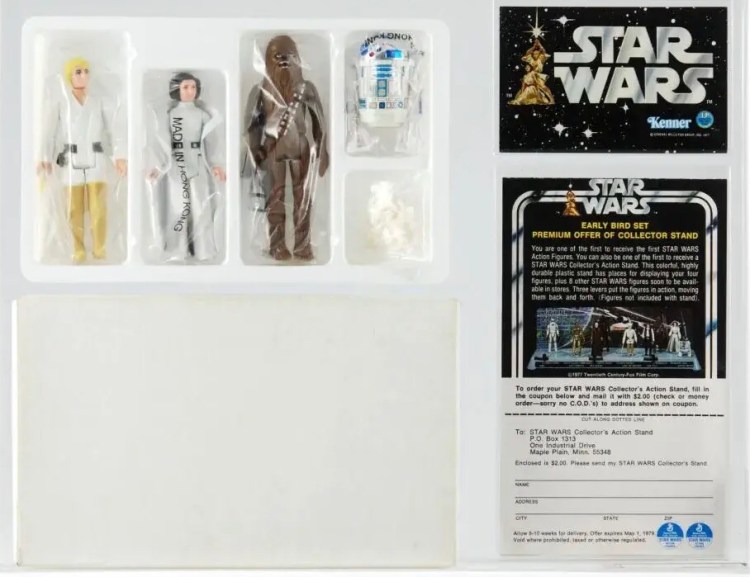
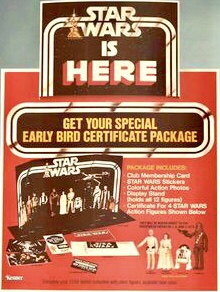
The Early Bird Certificate Package began with a “promise” of new Star Wars action figures. The certificate was basically the toy world’s first “pre-order”. It essentially said the consumer who purchased the Early Bird package would receive the first four Star Wars action figures ever, delivered right at their doorstep before ever being released to the general public. This was a brilliant promotional idea by Kenner, but one that was made out of necessity. Consumers gobbled them up quickly and it became a smash hit for Kenner. Along with the mail-order form that was needed to send in for the new figures, there were some other nice goodies inside the cardboard envelope as well. Included was a foldable cardboard stand, featuring portraits of each of the original 12 Star Wars figures, and small white pegs that would allow the figures to stand up on the display when inserted into the small holes on their feet. Also included were a cardboard photo of Han and Chewie, another cardboard photo of a Stormtrooper, a Space Club Card that could be filled out with your name on it, and a nifty Star Wars mini catalog featuring all of the upcoming Star Wars toys inside of it, including photos of all 12 of the upcoming action figures.

Then in early 1978, a plain white package arrived in your mailbox, containing the first four figures, Chewbacca, Princess Leia, R2-D2, and Luke Skywalker. The Luke figure is the most noteworthy of the four due to his lightsaber. It had the same arm-fed saber that other Luke figures had, but with an additional telescoping tip that could slide out to make the lightsaber even longer. Kenner quickly realized that additional piece was easily broken and unnecessary, so it was eliminated on future releases, making this Early Bird Luke figure very rare. The Leia, R2 and Chewbacca figures were essentially the same as the ones released at retail. Each figure came inside of a sealed plastic baggie, which were then all placed in a plastic tray that was grooved out to fit each figure.

The rest of the regular figures were released later in 1978, and the world was never the same. With all of their action figure and accessory innovations, Kenner began a new era in the toy industry and completely revolutionized how toy lines are marketed and sold to this date. Early Bird Certificates can still be found in their original envelopes on various secondary markets, but they tend to be on the expensive side, depending on condition. The Early Bird boxed figure sets can be VERY expensive to find, so make sure you have your bank loan paperwork pre-approved before you go on the hunt for a complete and sealed set.